
Illinois Teachers Prepare for Lessons on Impact of Drugs in Environment

Proper disposal of unwanted prescription drugs and other common chemicals is important because of their ability to alter living things when introduced into lakes and streams.

School teachers from across Illinois attended a workshop at the Illinois Sustainable technology Center June 15-16 to help them develop curricula about the risks of improper disposal of pharmaceuticals and personal care products (PPCPs) and the impacts of these emerging contaminants on the environment.


The training was conducted with the Illinois-Indiana Sea Grant College Program as part of a grant by the University of Illinois Extension to help raise awareness about the importance of proper disposal of unwanted prescription drugs and other common chemicals because of their ability to alter living things when introduced into lakes and streams.


According to Rebecca Wattleworth, a veteran teacher at Decatur’s Warrensburg-Latham High School, students and their families will benefit from these messages in their science classes. “When they come into my classroom they often do not realize the impact they have on the environment with their everyday activities,” she said. “They think when they throw it away, litter, etc. (that) it is just gone. Out of sight, out of mind.”


Wattleworth said she enrolled in the PPCP teacher workshop so she is prepared to show her students that their actions have consequences. “I want my students to learn that their everyday activities will have an impact in some way on the environment and that they need to be making better/safer choices for both the environment and us!”


Geoffrey Freymuth, a science teacher at Jefferson Middle School in Champaign, is attending the workshop to develop activities for his science enrichment class, as well as for the school’s student Green Team. “It has been my experience that students can have a great impact on the behaviors of their families and their habits,” he said. “I would like my students to be able to set up and design a local campaign on the issue or even find a way to test/evaluate local waters etc.,” he added.


Joni White, a science instructor at Urbana High School said “As an environmental science teacher, I am well aware that this is an often overlooked problem that seriously impacts the environment. I am eager to learn more about what is being done about it so that I can communicate its importance to my students.” She added “From a personal perspective, I am also a veterinarian and well aware of the medical field issue of pharmaceuticals ending up in the water supply.”


In an experiment designed for teachers to use in their classrooms, the workshop participants measured the effect of increasing concentrations of common PPCPs on growth of lettuce sprouts. The compounds used were Aspirin, road salt, and Epsom salt.
In an experiment designed for teachers to use in their classrooms, the workshop participants measured the effect of increasing concentrations of common PPCPs on growth of lettuce sprouts. The compounds used were Aspirin, road salt (MgCl2), and Epsom salt (MgSO4).

Each year, unwanted medications account for accidental poisonings and drug abuse and for environmental problems. The workshops will help this information about PPCPs become a part of each school’s curriculum, according to Nancy Holm, ISTC assistant director. “There are a number of sources of PPCPs to the environment but reducing as much improper disposal as possible is a step in the right direction.”


Recent studies reflect the growing concern about how these compounds enter the aquatic environment and their effects on wildlife.


  • Salmon in Puget Sound (Seattle) were found to be contaminated with antidepressants, pain killers, anti-inflammatants, fungicides, antiseptics, anticoagulants, and antibiotics. A total of 81 PPCP chemicals from nicotine and caffeine to OxyContin and cocaine.


  • Research by ISTC was among the first to confirm that the common antiseptic, Triclosan, was causing antibiotic resistance among bacteria in lakes and streams.


“This is a threat to public health and also the health of our ecosystems that every family has a direct role in preventing,” Holm added. “By providing this information to teachers they can then present this information to hundreds of students each year who can work to spread the word in their communities.”


2016 Teacher Workshop on PPCPs in the Environment

collored unlabeled pills spilling from an amber pill bottle ISTC and the Illinois-Indiana Sea Grant will be hosting a teacher workshop on pharmaceuticals and personal care products (PPCPs) in the environment. PPCPs encompass thousands of chemicals found in fragrances, cosmetics, over-the-counter drugs, and human and veterinary medicines. The U.S. EPA has identified PPCPs as emerging contaminants of concern because little is known about their impacts on ecosystems or risks to human health when they are released into the environment.

unlabeled personal care products bottles


If you are a teacher interested in learning more or know of a teacher who might be interested, please visit our PPCPs Teacher Workshop website for more information or to register for the workshop.


Teachers will have the opportunity to earn up to 8 professional development hours and a $100 stipend.

Details

WHEN? One Day: June 15 or 16, 2016, 8 AM to 5 PM


WHERE? Illinois Sustainable Technology Center (ISTC), 1 E. Hazelwood Drive, Champaign, IL 61820 (Google Maps location of ISTC)


WHO? Illinois and Indiana middle and high school and preservice science teachers can register.


COST? FREE with lunch provided plus a $100 stipend!


DEADLINE? Registration is open now until May 4, 2016, or until full. Registration is LIMITED to 30 participants per day. Don’t delay in registering!


men and women collaborating around a table with papers and charts

Watershed Management Online Training

Interested in learning more about water resources? The United States Environmental Protection Agency (U.S. EPA) offers a self-paced online training program in watershed management. There are 15 core modules (listed below) which the trainee must complete to receive the Watershed Academy Certificate. In addition, the training program offers 46 more modules that are optional for more in depth learning. A trainee is allowed to substitute up to 3 core modules for optional modules, if they wish.


Core Modules

Introductory/Overview

Watershed Ecology

Watershed Change

Analysis and Planning

Management Practices

Water Law

P2 Resources You Can Use

image001This post is adapted from a post that originally appeared on the GLRPPR Blog. See all of their P2 Week posts here.


In the not-to-distant past, it was difficult to locate pollution prevention and sustainability information. Those days are gone. Now, we go to Google and we’re inundated. In this post, I’ll point you toward some resources that you may have forgotten about when you’re trying to locate information to solve a problem. Whether you’re an organization that wants to start a sustainability program or a seasoned pollution prevention technical assistance provider, there’s something on this list that will help you do your job better.

ISTC Publications

ISTC publishes a number of fact sheets and reports of interest to P2 professionals. Most of these are included in our collections of fact sheets and technical reports.


If your company wants to learn more about implementing pollution prevention, be sure to take a look at Pollution Prevention : A Guide to Project and Program Implementation. Although it was last updated in 1999, the steps involved for establishing a pollution prevention or sustainability program in your organization are still valid.

Topic Hubs and LibGuides

Topic hubs and LibGuides are similar. Both are curated collections of resources on specific topics that also include explanatory information. The only difference is the delivery platform. GLRPPR converted its Topic Hubs to LibGuides several years ago. Guides of particular interest to the P2 community include:

The Pollution Prevention 101 LibGuide will be particularly useful to those new to the P2 field. It includes links to essential resources and training that will help get you up to speed quickly.

GLRPPR Sector Resources

GLRPPR’s sector resources are curated collections of documents organized by sector or topic. Each resource includes a link and a brief description. Sector resources includes links to fact sheets, manuals, videos, journal articles, case studies, and software tools. Browse by sector/topic or search by keyword using Google site search.

GLRPPR Webinar Archive

GLRPPR hosts two to three webinars per year. Recordings of these webinars are archived on their web site.

GLRPPR Help Desk

If you have a sustainability question or problem you’re trying to solve, the GLRPPR Help Desk is the place to visit. You get one free hour of literature/web searching and will receive a response within a week. Note that they won’t often give absolute answers. Instead, they’ll give you references and let your draw your own conclusions based on the available information. They also won’t answer homework questions.

E-Mail Discussion Lists and GLRPPR E-mail Newsletter

E-mail discussion lists are a great way to tap the hive mind of your pollution prevention colleagues. GLRPPR members are automatically subscribed to the Roundtable regional e-mail discussion list. P2Tech is an international discussion list for pollution prevention and sustainability professionals. To subscribe to either list, contact Laura Barnes.

GLRPPR’s e-mail newsletter keeps you up-to-date on sustainability news, resources, events, and funding opportunities. Subscribe here.

P2 Impact

P2 Impact is a collaboration between GreenBiz and the Pollution Prevention Resource Exchange. Each month, P2 practitioners write about topics related to pollution prevention and sustainability. The goal of the column is to tell the P2 story to GreenBiz’s business audience. The archives of the column are available here. If you would like to write a column, contact Laura Barnes.

P2 InfoHouse

P2 InfoHouse, maintained by the Pollution Prevention Information Center (P2RIC), is a searchable online collection of more than 50,000 pollution prevention (P2) related publications, fact sheets, case studies and technical reports. It includes a vast number of legacy pollution prevention documents that were originally released in hard copy. The collection is searchable by keyword.

Zero Waste Network Success Story Database

The Zero Waste Network’s Success Story Database contains case studies that are examples of how real facilities saved money, reduced waste, and/or lowered their regulatory burden through innovative P2 practices. The studies are often written in a companies own words, with minimal editing.

Free Green Lunchroom Challenge Kickoff Workshop & Training, Sept. 17

A free kickoff workshop and training for the Green Lunchroom Challenge, a voluntary competition among K-12 schools to improve the sustainability of their food service operations, will be held on Thursday, September 17 in the Stephen J. Warner conference room at ISTC from 10:00 AM to 2:00 PM. The workshop will provide an overview of the Challenge, presentations on relevant tools and programs, discussions of barriers and opportunities related to food waste prevention and reduction in K-12 schools, and a school food service training session presented by Greg Christian, Founder and CEO of Beyond Green Partners, a food service and consulting company focused on nutritional and environmental impacts of school food.


Registration for this workshop is limited to 40 participants. Please note that you do NOT need to participate in the workshop in order to participate in the Challenge itself. Interested schools may sign up for the Challenge at any time during the Challenge period (Sept. 1, 2015 – April 1, 2016) at www.greenlunchroom.org.


The training presented by Greg Christian will take place during the final two hours of the half-day workshop, and will cover the problem of food waste, multiple barriers to its reduction, front and back of house waste, measurement techniques to identify opportunities for improvement, and a systems approach to waste reduction, drawing on Greg’s personal experiences and methods for maintaining a zero waste kitchen. The two hours of in-person training can be counted by school nutrition/food service professionals as continuing education for the USDA Professional Standards which went into effect on July 1, 2015 (See http://www.isbe.net/nutrition/htmls/snp-prof-stds.htm). Attendees will need to keep track of the training agenda, hours, and proof of attendance. ISTC will have a sign-in sheet at the event and can send you an email afterward confirming your presence at the training.


For more information on the workshop and to register online, see www.greenlunchroom.org/?kickoff. Questions may be addressed to Joy Scrogum.


The Green Lunchroom Challenge is sponsored by US EPA Region 5.
 

Green Lunchroom Challenge logo

PCB Expert to Update Legacy and Emerging Issues at A&WMA Union League Club

Dr. Amanda Hughes was a primary presenter at the Prairie Research Institute's scientific workshop on PCBs at the University of Illinois in Chicago in September, 2014.
Dr. Amanda Hughes was a primary presenter at the Prairie Research Institute’s scientific workshop on PCBs at the University of Illinois in Chicago in September, 2014.

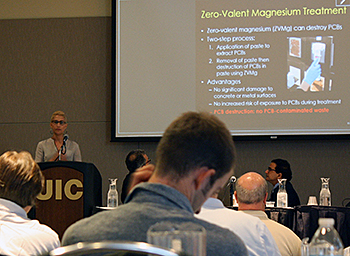
Amanda Hughes, one of the star experts at the Prairie Research Institute’s Sept. 17 workshop on “PCBs and Their Impact in Illinois” will be the special guest speaker at the Air & Waste Management Association, Lake Michigan States Section June Environmental Breakfast on Tuesday, June 23.


Hughes, of Geosyntec Consultants, will speak on “The Longstanding and Emerging Challenges of Addressing Polychlorinated Biphenyls.” Polychlorinated biphenyls (PCBs) seemed great in their day — a set of durable synthetic molecules prized for their toughness in a variety of industrial uses. When they were found to pose human health risks they were banned, but they are still around.


From the Institute’s work, a report was published which can be downloaded HERE.  Panel presentations by Dr. Hughes and others are also available for viewing at the workshop website. There is also an informative Library Guide published by the U of I Libraries HERE.


Registration is required for the 8-10 a.m. breakfast and payments ($40 ($20 students)) can be made at the organization’s website. The event is CLE and PDH credit-eligible.


College, University Recyclers Set the Stage for Generation ‘Green’

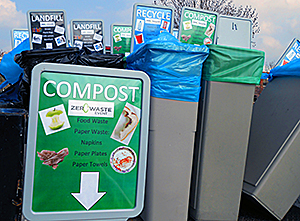
Multi-bin recycling is a key to zero-waste strategies.
ISTC’s Zero Waste Program is innovating on the University of Illinois campus as a partner of student and administration leadership

College and university administrators going to the Illinois Recycling Association’s (IRA) June workshops for higher education will be inspired by the great ideas included on The Best Colleges dot org website.

ISTC is one of the sponsors of two training workshops for Illinois colleges and universities on planning, audits, analyzing data and other issues. Kennedy-King College will host a workshop for the City College of Chicago from 9 a.m. – 3 p.m. Wednesday, June 10. The deadline to register is June 10. Illinois Central College will be the site of the second workshop from 9 a.m. – 3 p.m. Wednesday, June 17. (Meet in the morning at nearby Embassy Suites, East Peoria.)  The deadline for that one is June 12. The East Peoria workshop is conveniently scheduled the day before the IRA/ILCSWMA/SWANA Annual Joint Conference. For more information and to register, visit http://www.illinoisrecycles.org/events/2015-conference/pre-conference-college-seminars/.

As far as hip green universities go, we can all envy UC Davis’ commitment to zero-waste, which they plan to achieve by 2020. They have had their version of the U of I’s ‘Dump and Run’ since 1975. Such programs allow students to ‘donate’ good stuff they don’t want to take home and sell it back to other students next semester.

Maine’s College of the Atlantic is another beacon of greenness, where students recycling enterprise is ubiquitous.  It is easy to recycle on campus and reportedly, no pizza crusts ever escape the compost bins.

Here in Illinois, take notes from Loyola University Chicago, which is featured in the latest One Billion Gallon Water Challenge Research Update. Faculty, students and staff there are the focus of experiments to improve water conservation behavior on campus. Their goal is to save up to three million gallons of water a year. They are designing a Resource Tool Kit to share their results with other Illinois colleges and universities.

Talk about student leadership of the green hue, it is hard to beat the University of Illinois Urbana-Champaign where year’s ago students voted to charge themselves a Sustainability Fee. Since then the Student Sustainability Committee has used the fee to drive green initiatives in many fruitful directions. Read here some recent results of their leadership.


Noon Extension Seminars Explore Planning for Climate Change

GAMEBOARDThe U of I Extension Webinar series begins tomorrow, Tuesday, Jan. 13, on the theme of “Planning for Climate Change.”

 
Don Fullerton, Gutgsell Professor of Finance and Institute of Government and Public Affairs at the U of I, will lead off the series with a discussion of how the “U.S. Clean Power Plan Provides Opportunity for Significant Cuts in Budget Deficits.”

 
The fall ISTC seminar series is now also viewable on-line at http://www.istc.illinois.edu/about/ sustainability_seminars.cfm dealing with Sustainability Planning and Climate Change.

 
Together they promise a valuable resource for groups and organizations of all sizes to engineer society’s pivot toward a carbon-limited future.

 
Register for tomorrow’s Extension webinar at: http://web.extension.illinois.edu/lgien/.
More highlights:
Tuesday, Feb. 17, Edith Makra, The Metropolitan Mayors Caucus, “The Greenest Region Compact.”
Tuesday, March 10, Andy Robinson and Todd Rusk, Smart Energy Design Assistance Center, “Case Studies in Municipal Energy Conservation.”
Tuesday, April 14, Eliana Brown and Lisa Merrifield, IL-IN SeaGrant, “Green Infrastructure and Stormwater Management.”

ISTC will announce its Spring Semester Sustainability Series shortly.

Previous ISTC sustainability planning webinars are available on-line:

Upcoming Food Waste Training & Toolkit Piloting Opportunities

Several upcoming training opportunities are available for those interested in zero waste, specifically the reduction of waste in food service operations.


The US EPA Sustainable Materials Management (SMM) program will present a webinar on January 15, 2015, entitled “Food Waste Reduction Alliance, a Unique Industry Collaboration.” The webinar will take place from 12:00 to 1:30 PM CST. Online registration is available.


As defined by EPA, sustainable materials management (SMM) is “a systemic approach to using and reusing materials more productively over their entire lifecycles. It represents a change in how our society thinks about the use of natural resources and environmental protection. By examining how materials are used throughout their lifecycle, an SMM approach seeks to:

  • Use materials in the most productive way with an emphasis on using less;
  • Reduce toxic chemicals and environmental impacts throughout the material life cycle;
  • Assure we have sufficient resources to meet today’s needs and those of the future.”

The Food Waste Reduction Alliance (FWRA) is a collaborative project of the Grocery Manufacturers Association (representing food and beverage companies), the Food Marketing Institute (representing food retailers), and the National Restaurant Association (representing the food service industry), working to reduce food waste generation, increase food donations to the needy, and to divert unavoidable food waste from landfills through recycling.


In addition to the webinar overview of the FWRA, there will be a series of free webinars to guide users through the waste assessment and reduction process presented in the Reducing Wasted Food & Packaging Toolkit (available at http://www.epa.gov/foodrecovery/tools/). All are welcome to participate. The schedule for that series is below. Click on a webinar title to register online.


US EPA Region 9 is also inviting food service facilities (restaurants, cafeterias, grocers, and other commercial and institutional kitchens) in California, Nevada, Arizona, Hawaii and the Pacific Islands to pilot the toolkit. Along with the free webinar series, pilot participants are offered one-on-one technical assistance from an EPA team member; the opportunity to participate in peer groups to troubleshoot the tracking process; the chance to present in future EPA webinars; and the ability to jumpstart or enhance participation in the EPA’s Food Recovery Challenge. Learn more about the opportunity to pilot the Reducing Wasted Food & Packaging Toolkit at http://go.usa.gov/MuGA.


Questions can be directed to Amanda Hong at hong.amanda@epa.gov. Thanks to Amanda for sharing information on these opportunities.


MREA PV 320.03 Solar Training Academy Begins in Normal, January 2015

MREA Solar AcademyThe Midwest Renewable Energy Association (MREA) will be offering its PV 320.03 Solar Training Academy beginning January 17th, in Normal, IL.


The MREA Solar Training Academy is a series of weekend classes that will walk students through the photovoltaic (PV) design and installation process. The format of the Solar Training Academy will be MREA’s class progression that will include Basic Photovoltaics, PV Site Assessor, Intermediate PV, PV Design Lab and PV Sales and Finance. Classes will be held one weekend each month beginning in January and concluding in early May. Topics of this training will cover PV equipment selection, utility intertied and battery based systems, batteries, mechanical and electrical integration, PV design, PV residential site assessment, National Electric Code, system commissioning, solar financials. Participation in the Solar Training Academy will also include opportunities to meet with professionals in the solar industry.


Upon successful completion of the Solar Training Academy, students will qualify for:

  • Completion of 63 hours of classroom training for North American Board of Certified Energy Practitioners (NABCEP) PV Installation Professional and NABCEP PV Technical Sales Professional
  • Sit for the NABCEP Entry Level Exam
  • Sit for the MREA PV Site Assessor Exam (To sit for the MREA PV Site Assessor Exam, students will need to complete two practice site assessments outside of class.)

The course instructor is Alex Jarvis, of Solar Systems of Indiana.

Non MREA Member Price = $2,200.00; MREA Member Price = $2,000.00.


For complete information, and registration, visit https://www.midwestrenew.org/civicrm/event/info?id=728&reset=1.


For more information on training available through MREA, see https://www.midwestrenew.org/training.