

In a previous post on back-to-school sustainability resources, the Illinois Climate Education Hub was mentioned as a forthcoming resource for K-12 teachers, to assist them in complying with Public Act 103-0837. That legislation provides that, “Beginning with the 2026-2027 school year, every public school shall provide instruction on climate change, which shall include, but not be limited to, identifying the environmental and ecological impacts of climate change on individuals and communities and evaluating solutions for addressing and mitigating the impact of climate change and shall be in alignment with State learning standards, as appropriate. The State Board of Education shall, subject to appropriation, prepare and make available multi-disciplinary instructional resources and professional learning opportunities for educators that may be used to meet the requirements of this subsection.”
The hub is now live and is available at https://illinoisclimateeducation.org/. The IL hub (like its sister hubs in New Jersey, Oregon, Wisconsin, Maine, New York, Connecticut, and Michigan) provides free, educator-vetted teaching resources, professional development opportunities, lesson plan examples, and relevant news articles for students. All resources on the hub can be used for educational purposes with proper attribution to the content provider.
Photo by wavebreak3– stock.adobe.com (Education license, University of Illinois Urbana-Champaign)
Time flies, and August is upon us already, so it will soon be back-to-school time in IL. Whether you’re a parent, student, or educator, if visions of classrooms or campuses are dancing in your head, the following resources will help you prepare for the new school year. As always, please keep in mind that links to specific products or services are provided for informational purposes only and do not constitute endorsement by ISTC, the Prairie Research Institute, or the University of Illinois.
Did you know that beginning next fall, IL K-12 public schools are required to provide climate change education? Public Act 103-0837, signed into law by Governor J. B. Pritzker in August 2024, provides that, “Beginning with the 2026-2027 school year, every public school shall provide instruction on climate change, which shall include, but not be limited to, identifying the environmental and ecological impacts of climate change on individuals and communities and evaluating solutions for addressing and mitigating the impact of climate change and shall be in alignment with State learning standards, as appropriate. The State Board of Education shall, subject to appropriation, prepare and make available multi-disciplinary instructional resources and professional learning opportunities for educators that may be used to meet the requirements of this subsection.”
An organization called SubjectToClimate is already leading efforts to develop an Illinois Climate Education Hub. The goal of the online hub is to make it easier for Illinois K-12 educators of all grade levels and subjects to teach about climate change by providing access to free, vetted teaching resources, professional development opportunities, lesson plan examples, and more. They’ve previously created similar hubs for New Jersey, Oregon, Wisconsin, Maine, New York, Connecticut, and Michigan. Check our their “Get Involved” page if you’re interested in being part of the effort, or reach out to Katie Nahrwold, the Illinois State Lead, for more information. While the IL hub has yet to be launched (the tentative launch date is September 10, 2025), teachers may still consider registering for an account on the SubjectToClimate website to browse teaching resources already available. Resources can be searched by grade, subject, resource type, standards, providers, locations, and languages. You can also use online forms to suggest teaching resources or suggest a teacher professional development opportunity.
The Australian Curriculum, Assessment and Reporting Authority (ACARA) defines education for sustainability (EfS) as follows (as relayed on the Getting Started with Sustainability in Schools website): “Education for sustainability develops the knowledge, skills, values and world-views necessary for people to act in ways that contribute to more sustainable patterns of living. It enables individuals and communities to reflect on ways of interpreting and engaging with the world. Sustainability education is futures-oriented, focusing on protecting environments and creating a more ecologically and socially just world through informed action. Actions that support more sustainable patterns of living require consideration of environmental, social, cultural and economic systems and their interdependence.”
Similarly, UNESCO uses the term “education for sustainable development,” or ESD, stating “Education for Sustainable Development empowers people with the knowledge, skills, values, attitudes and behaviors to live in a way that is good for the environment, economy, and society. It encourages people to make smart, responsible choices that help create a better future for everyone.” The UNESCO ESD website provides a variety of resources to explore, along with its Education for sustainable development for 2030 toolbox.
The Cloud Institute for Sustainability Education provides professional development opportunities, EfS standards and indicators, and a variety of other resources to support educators interested in integrating sustainability in their curricula.
Illinois Green Schools Project:https://www.illinoisgreenalliance.org/illinois-green-schools-project-home. According to the Illinois Green Alliance, this is “an annual sustainability action and recognition program for K-12 schools in Illinois. We help educators engage students and school stakeholders in hands-on projects that improve health, efficiency, and environmental impact.”
Green Lunchroom Challenge archive: Launched in 2015, the Green Lunchroom Challenge (GLC) was a voluntary pledge program for K-12 schools to improve the sustainability of their food service operations. By registering, participants were accepting the challenge to reduce and prevent food waste in their facilities. The GLC website provided suggested activities that ranged in complexity and commitment, to allow participants to best suit their situation, budget, and available community resources. Participants were not required to complete activities, but with each activity that was completed successfully, they earned points toward recognition at different levels of accomplishment. When the project ended, material from the original website was folded into a topical blog that also included information on food waste reduction for sectors besides K-12 schools. The archived blog is available at https://wayback.archive-it.org/6086/20250528191406/https://green-lunchroom.istc.illinois.edu/ or . See https://tap.istc.illinois.edu/2016/12/07/green-lunchroom-challenge/ for further project information.
The US EPA estimates that in 2019 alone, 66 million tons of wasted food was generated in the food retail, food service, and residential sectors, and most of this waste (about 60%) was sent to landfills. Food Waste Prevention Week (FWPW) is a collaborative effort to raise awareness about food waste and its negative impacts on our society and environment, while also sharing resources to help individuals, families, and organizations reduce their food waste. Because the Illinois Sustainable Technology Center (ISTC) Zero Waste team has experience working on food waste reduction and management projects, ISTC is proud to be a FWPW partner organization for the third year in a row!
Be sure to check ISTC’s social media platforms during April 7-13, for highlights of relevant projects, as well as facts and resources to help you on your food waste reduction journey. If you’re not already following us on social media, you can connect with us on Facebook and LinkedIn.
How do I get involved?
The FWPW website provides a wealth of information to help various sectors with food waste prevention efforts, including descriptions of webinars presented by partners across the country. Here are just a few suggestions for relevant activities and webinars, arranged by sector, including links to ISTC and partner organization resources, as well as links to appropriate sections of the FWPW website for further information and inspiration. Links to specific programs or services are for informational purposes only and should not be construed as endorsements by ISTC, the Prairie Research Institute, or the University of Illinois Urbana-Champaign.
Colleges & Universities
Host a “Weigh your Waste” event to get students involved and to illustrate the magnitude of food waste generated. Uneaten food from student trays from a single meal period is collected, weighed, and put on display. This offers opportunities for discussion around the causes of waste and encourages students to brainstorm ideas for reduction. See this case study from Chapman University for inspiration.
Promote your campus chapter of the Food Recovery Network (FRN), or consider forming one if your campus is not yet participating. FRN is a non-profit that unites students with businesses and other community partners to recover perishable food and fight hunger while simultaneously fighting waste.
Register for these webinars (and check the FWPW webinar page regularly for addition of similar events):
Check out the NRDC Food Matters Beginner’s Guide. The NRDC Food Matters project partners with cities to achieve meaningful reductions in food waste through comprehensive policies and programs. This guide introduces policymakers, agency staff, and activists to the project and provides resources related to food waste reduction and communication strategies, as well as case studies from successful initiatives in partner cities.
Use the NRDC Guide to Making a Public Commitment on Food Waste. This can be a way to harness local leadership and constituent buy-in, while increasing accountability, and helping your city serve as inspiration for peers in other locations.
Register for these webinars (and check the FWPW webinar page regularly for addition of similar events):
See this page for additional information for restaurants.
Individuals & Families
Explore the resources at Savethefood.com, including recipes to use up ingredients and leftovers, storage tips to keep food fresh longer, a tool to estimate the amount of food you’ll need for a certain number of guests, and other planning suggestions.
Register for these webinars (and check the FWPW webinar page regularly for addition of similar events):
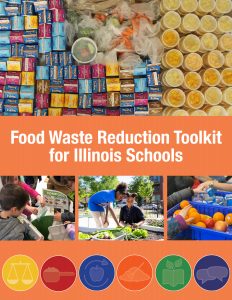
Just in time for the 50th Anniversary of Earth Day, the Wasted Food Action Alliance is pleased to announce the release of the Food Waste Reduction Toolkit for Illinois Schools. Though schools throughout the state are currently closed due to the COVID-19 pandemic, this toolkit will allow districts and food service staff members to make plans for food waste reduction efforts when schools are able to welcome back students and staff in person.
The Wasted Food Action Alliance is a diverse set of organizations helping build a unified approach towards reducing wasted food and leveraging it to benefit our region. Its mission is to develop a working strategy and action platform that makes Illinois a leader in reducing wasted food by connecting and building on current wasted food initiatives, education, and policy in unified ways that holistically promote source reduction; food recovery for hunger relief and other uses; and recovery of food scraps for composting and creating healthy soil.
Joy Scrogum, a member of ISTC’s Technical Assistance Program (TAP), is part of the Wasted Food Action Alliance subcommittee which developed the school food waste reduction toolkit. Joy coordinated ISTC’s Green Lunchroom Challenge project, and continues to work on food waste prevention and reduction through TAP’s work with clients, the Illinois Food Scrap Coalition, and related local and regional projects. The Wasted Food Action Alliance school toolkit subcommittee was lead by Seven Generations Ahead.
What’s the problem with food waste in schools?
Over 7 billion school meals are served each year in the United States. Much of this food, however, is currently feeding landfills instead of nourishing students. This is while one in six children is food insecure. When food is landfilled, not only are its nutrients lost, so are all the energy, water, and labor that went into producing, transporting, and preparing it. K-12 schools have a unique role in teaching students to value food instead of wasting it.
The Food Waste Reduction Toolkit for Illinois Schools can help.
The Toolkit is a comprehensive resource that provides all schools, no matter their size or location, the tools to tackle the issue of wasted food. It identifies the main sources of wasted food and offers strategies for food waste prevention, recovery and redistribution, composting, education and engagement, and celebrating success. A variety of solutions are shared–from easy and quick to implement to longer term and more resource intensive.
The Toolkit’s easy to use format allows you to jump in to find the strategies that work for your school. Each section includes case studies that highlight inspirational efforts to reduce food waste in schools across Illinois and provides guidance on:
Measuring food waste
Waste audit guides
How to determine what to audit in your lunchroom and kitchen
Food waste tracking in kitchens
Analyzing waste audit data
Preventing food waste
Sourcing food from school gardens and local farms to encourage consumption of healthy foods
Menu planning and food preparation
Preventing food waste at the serving line, including Offer versus Serve
Recovering and redistributing surplus food
Policies and laws regarding share tables and the redistribution of food (including the Bill Emerson Good Samaritan Food Donation Act that supports the donation of recovered food)
How to set up and operate a share table
Redistribution of surplus food within a school
Donation of surplus food to an outside organization or in-school food pantry
Composting food scraps
The environmental benefits of composting
Onsite composting
Offsite commercial composting
How to get started composting in your lunchroom
Educating and engaging the school community
Hands-on classroom or service learning projects
Curricula and lessons about food and food waste
Teaching tools and resources
Communicating and celebrating success
Communications within school community
Communications with the wider community
Get recognized with programs such as Green Ribbon Schools and the U.S. Food Waste Challenge