

International Compost Awareness Week and Illinois Compost News

International Compost Awareness Week (ICAW), falling on May 7-13 this year, is celebrated during the first full week in May annually. The event began in Canada in 1995 and has since grown as more and more organizations and individuals become aware of food waste issues and recognize the value of composting as a waste reduction strategy with multiple environmental benefits. The theme for this year’s celebration is “Compost! Healthy Soil, Healthy Food.” Learn more at http://compostfoundation.org/icaw.


IL Economic Impact and Market Study
Composting food scraps also has economic benefits as illustrated in a recent report produced by Skumatz Economic Research Associates (SERA). Building on the 2015 Food Scrap Composting Challenges and Solutions in Illinois  report produced by recent collaboration with the Illinois Food Scrap Coalition (IFSC), Seven Generations Ahead (SGA) contracted SERA to identify the problems associated with landfilling organics, food scraps in particular, and recommend solutions emphasizing the development of the Illinois sustainable food industry. The goals of the project were to examine the influence of expanded food scraps recovery and composting programs on improving the viability of commercial composting ventures in Illinois, drive Illinois-based food production, and enhance the local food economy in Illinois, including jobs and revenues.


Analyses in this report indicate that the three targeted organic materials – food scraps, compostable yard waste (not including woody materials), and compostable paper– represent significant recoverable resources. Diverting these target materials would reduce 22% of tons disposed, and 16% of the MTCO2e available from all the non-recovered recyclables and organics disposed annually in Illinois. Using estimates of future prices of carbon dioxide, the value of the carbon dioxide represented by the target food scraps is $54 million – $89 million annually (2020 prices). SERA found that if IL can achieve a 65% organics diversion goal, the state will realize 3,185 jobs paying an average salary of $50k annually, $290 million annually in economic output, $10.5 million annually in local and state tax revenue, over 2 million tons of material diverted from landfill annually, and over 800k MTCO2e in GHG emissions reduction annually. This all makes composting of organics seem like a sound environmental and economic investment.


The report recommends a multiyear implementation plan for statewide diversion programs, citing Vermont’s Universal Recycling Law (Act 148) as an example. Recommended steps include: setting a statewide goal for organics diversion; adding food wastes to the existing yard waste landfill ban; adding tip fee surcharges for landfilled organics; introducing commerical and residential a Pay-As-You-throw (PAYT); promotion of urban gardens and backyard composting; grant programs to assist businesses and communities with food scrap composting; organics diversion requirements for sectors generating the most material; measurement strategies; and clarification for food donation regulations and encouragement of food recovery.


To download the full report, Economic Impact and Market Study Report: Elements of the Case for Advancing Food Scrap Composting Industry and the Link to Building Illinois’ Local Food Economygo to http://illinoiscomposts.org/images/pdfs/Economic-Impact-Report.pdf.


Village of Lake Bluff and City of Highwood (IL) Offer Year-Round Food Scrap Programs
Meanwhile, as part of their celebration of ICAW, leaders from the Village of Lake Bluff, the City of Highwood, the Solid Waste Agency of Lake County (SWALCO), and recycling businesses held a press conference May 10th to discuss year-round curbside collection of food scraps and yard waste for residents in those municipalities.  They are the latest in a small number of IL communities offering similar services. Starting this month, Highwood is requiring residents to separate food scraps from other waste to keep these materials out of landfill. For more information, read the media advisory on the press conference, coverage in the Chicago Tribune on 5/1/17 and 5/10/17, and a document from SWALCO outlining Lake County’s food scrap composting options.


Approval for Composting Facility near Des Plaines, IL Moves Forward
Elsewhere on May 10, Patriot Acres, a proposed composting facility outside of Des Plaines, received approval from the Cook County Board of Commissioners. The facility has faced opposition from some residents who are concerned about odors among other issues. Patriot Acres has agreed to offer a complaint line, operate within set hours, and abide by a list of environmental requirements. Approval from Cook County allows Patriot Acres to move forward with requests for approval from the IL Environmental Protection Agency and the Metropolitan Reclamation District of Greater Chicago. To read more about the proposed facility and the debate surrounding it, see the 5/12/17 edition of WasteDive.


IL Resident Wins ICAW Poster Contest
Incidentally, as part of each year’s ICAW celebration, there is a contest for poster designs reflecting the year’s theme. This year’s winner is Ursula Gutowski a graphic designer from Niles, IL. You can read more about Ursula and her inspiration at http://compostfoundation.org/ICAW-Poster-Contest. To order a copy, visit the ICAW online store. More information about the 2018 poster contest will be available soon on the Composting Council’s Research and Education Foundation web site.

2017 ICAW poster contest winning design

Focus on Food Waste: Recent and Upcoming Food Waste Events

Interested in ways to fight food waste in your organization or community? Be sure to check out these upcoming events, as well as archived resources from recent events.

Upcoming Events

US EPA Sustainable Materials Management (SMM) Web Academy Webinar: New Tool Kit: Reforming Laws and Policies to Enhance Food Recovery at the State and Local Level

Thursday, Oct 20, 2016 12:00 PM – 1:30 PM CDT; Register at https://attendee.gotowebinar.com/register/7992718732755591171


In September 2015, the United States Department of Agriculture (USDA) and United States Environmental Protection Agency (EPA) announced the first ever domestic goal to reduce food loss and waste by half by the year 2030 and are seeking to work with public and private partners to take action and make this happen over the next 14 years. The Harvard Food Law and Policy Clinic (FLPC) is one of EPA’s partners and is at the forefront of identifying key areas where current laws create barriers to reducing this food waste or where policies can incentivize more food recovery, and is actively working on the federal and state level to help reform those laws. One way to assist with the proliferation of better food recovery laws and policies is by providing information to states and local governments regarding methods of increasing food recovery. In order to make such information more widely available, FLPC created a toolkit for state and local policymakers interested in reducing food waste. This toolkit brings together lessons from their research and policy work in date labeling, tax incentives, liability protections, organic waste bans, leftovers for livestock as well as other food waste policies, to provide state and local policy makers with a comprehensive menu of policy options to reduce food waste.


Join this webinar to learn what is included in this toolkit, and how you can use it in your state or local food waste policy planning. Presenters will explain the content and how best to use the toolkit, with a focus on a few of the sections, and will answer questions from webinar participants about these and other examples.


Controlling Food Waste in School Food-Service

Thursday, Oct 20, 2016, 10:30 AM to 1:30 PM CDT, Hillsdale, IL;  Space is limited–RSVP to carl@pbjreps.com or pj@pbjreps.com.


ISTC’s Joy Scrogum will be among the presenters, talking about the Green Lunchroom Challenge Program. Other presenters will covers topics such as speed scratch cooking, presenting freshness, preserving freshness, holding freshness, storing freshness and more. Learn about food waste reduction while supporting a great cause! The event is free with a suggested $10 donation at the door. Proceeds will benefit the Greater Chicago Food Depository; PBJ Commercial Agents will be matching donations. See http://www.greenlunchroom.org/documents/Controlling-Waste-PBJ.pdf for more information.


Composting Policy Forum

Monday, Oct 24, 1:00 PM -3:00 PM CDT,  Chicago Botanic Garden, 1000 Lake Cook Rd, Glencoe, IL 60022; Register at https://docs.google.com/forms/d/e/1FAIpQLSdO69XnWKyU-NCLmXTzr8n6SyAteHCkVoAdSaQOMulOmgvprA/viewform.


Seven Generations Ahead, the Illinois Environmental Council, the Solid Waste Agency of Northern Cook County and the Illinois Food Scrap Coalition invite you to attend the third in a series of four free forums addressing composting policy in Illinois. Get updates on food scrap composting initiatives in Northern Cook County. Learn about Illinois landfill disposal bans and their impact. Discuss what would be needed for a successful organics disposal ban in Illinois. View the agenda online.


Recent Events

US EPA SMM Web Academy Webinar: Food: Too Good to Waste – Community Results and Lessons Learned

Sept. 22, 2016; View archived presentation materials online.


Currently, over 30 percent of the food currently grown and processed in the U.S. goes uneaten. When wholesome, edible food ends up in a landfill, all those embedded resources (along with the money spent on them) also get wasted. This impacts the environment, our community and the bottom line. The Food: Too Good to Waste toolkit was designed and developed for local governments and other community partners to help prevent wasted food in households. This community food waste prevention toolkit has been tested throughout the US and helps households save money while reducing wasted food by up to 50%. During this webinar we will present results from an evaluation report on several campaign implementations and hear from three of those communities who successfully implemented this toolkit.


Michigan DEQ Sustainability Series Webinar: Engaging in Food Recovery

Sept. 22, 2016; View archived slides and recording online (Note: Scroll to the bottom of the page).


Food scraps are the “final frontier” for organics recovery. Food is the most water, labor and nutrient intensive of the wastes we produce. And not all food that is wasted is unfit for a plate. Food recovery should come first. After that, diversion from landfills, then identifying the best options to recover what value we can from what we worked so hard to grow. Learn how your business or organization can avoid wasting this valuable resource. This webinar was geared towards any business or institution that generates food waste in a kitchen or cafeteria or through food processing, as well as anyone interested in learning more about food waste recovery. Presented by Sally L. Brown, PhD, a Research Associate Professor at the University of Washington. She is a Fellow in the Soil Science Society of America, and was a member of the National Academy of Science Committee on Soils. She writes a monthly column for Biocycle magazine and a blog for the Huffington Post.


Green Lunchroom Challenge Webinar, Sept. 30, Features Innovative School Projects

Join us on Friday, September 30, 2016 for a Green Lunchroom Challenge Webinar, “School Gardening and Composting at Salem High School (MA).” The webinar will be broadcast from 11:30 AM to 12:30 PM Central, and will be recorded and posted to the Challenge web site for later viewing. Register online at https://attendee.gotowebinar.com/register/2878734024751555843.


Learn about innovative on-site gardening and composting efforts at Salem High School (Salem, MA). These projects not only provide fresh produce for school meals, but also engaging experiential learning opportunities for students. Our presenters will be Graeme Marcoux, Salem High School science teacher, and Deborah Jeffers, Food Services Director. This school not only has traditional garden plots, but also grows produce in a modified, climate controlled shipping container from Freight Farms. This atypical approach to on-site gardening allows the school to generate more fresh produce than they would with their traditional plots alone, and can allow growing during any season. This CBS Boston feature on the school’s efforts provides more information, and may help you formulate questions you’d like to ask during the webinar: http://boston.cbslocal.com/video/category/news-general/3411386-eye-on-education-students-grow-fresh-healthy-food-for-cafeteria/#.V1cjQm52EV9.wordpress.


Coordinated by ISTC with funding from US EPA Region 5, the Green Lunchroom Challenge is a voluntary pledge program for schools to improve the sustainability of their food service operations. By registering, participants are accepting the challenge to reduce and prevent food waste in their facilities. The Challenge involves suggested activities that range in complexity and commitment, to allow participants to best suit their situation, budget and available community resources. Participants are not required to complete activities, but with each activity that is completed successfully, they earn points and can be recognized as having achieved different levels of accomplishment. Learn more, and register your school or district, at www.greenlunchroom.org.


Green Lunchroom Challenge logo

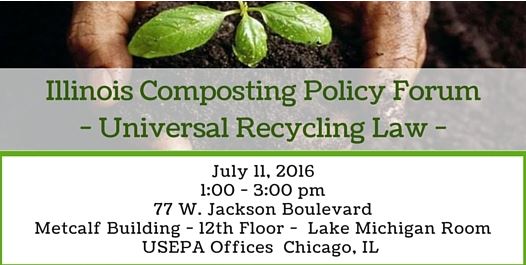
Illinois Composting Policy Forum July 11 in Chicago

IFSC Policy forum information


Seven Generations Ahead, the Illinois Environmental Council and the Illinois Food Scrap Coalition (IFSC) invite you to participate in an Illinois Composting Policy Forum on July 11, 2016 from 1 to 3 PM at the Ralph H. Metcalfe Federal Building in Chicago, IL. This will be the first in a series of four forums exploring the potential policy solutions proposed in IFSC’s 2015 report, Food Scrap Composting Challenges and Solutions in Illinois.


The forum will provide updates on the composting policy and infrastructure work of the IFSC and the Illinois Environmental Council. Attendees will learn about states that have a Universal Recycling Law and the impact of these laws, and will participate in a deep dive discussion of the impact such a law would have in Illinois.


Register online at this link. Funding for this free forum is provided by the Searle Funds of the Chicago Community Trust.


For questions about this forum, please contact admin@sevengenerationsahead.org.

Celebrate International Compost Awareness Week

In the US, the beginning of May has people thinking of several celebrations, including Cinco de Mayo, Mother’s Day, and even Star Wars Day (May the 4th, as in “May the Fourth Be With You”). But did you know the first week of May is also celebrated annually as International Compost Awareness Week?


Composting allows organic materials, such as food scraps and yard waste, to break down naturally into a nutrient rich resource that can be used in gardening and landscaping in place of commercially available fertilizers. Application of compost reduces erosion, and can help your soil retain water, reducing costs associated with watering and contributing to water conservation. Composting can also reduce waste hauling costs, as well as greenhouse gas emissions associated with the breakdown of organic materials in landfills in the absence of oxygen.


If you’d like to learn more about composting, check out the following resources:


If you’re a college or university student interested in pursuing research related to composting, check out the CCREF Young Investigator Scholarship.